Category Archives: Uncategorized

The Cats of Canea…or, possibly, Spinalonga.

Readers will notice that cats are conspicuously absent from this illustration of French troops in Canea, published in Le Petite Journal on 20th June 1897.

There may be a reason for this.

The following article appeared on page 8 of the Pall Mall Gazette on 1st August 1899:

“WHY THE PET CATS DISAPPEARED.

The Vienna Neue Freie Presse has been publishing some details respecting the behaviour of the international troops quartered in Crete. An entertaining item is given respecting French soldiers. It seems that the second batch of French troops, who came to Crete after the departure of the Turks, seized all the cats they could find in Canea and Halepa and ate them. When, however, a large number of specially pet animals had thus disappeared, a great and indignant outcry on the part of the inhabitants arose. Accordingly the commander, to avoid serious trouble, had to issue a very drastic prohibition of cat-catching, which he embodied in an order of the day. But the practice was checked with difficulty.”

While the above might seem to be nothing more than a bit of anti-French propaganda, it appears that it might have some basis in fact.

Writing a series called Memories of a Sailor, published in the French newspaper “Le Courrier” between 1st June 1 and 6th July 1939, Émile Amédée Dupourqué who had been a Lieutenant de Vaisseau (Royal Navy equivalent rank Lieutenant) in the French navy in 1897 and in charge of the fortress of Spinalonga in 1897 and 1898, recalled his time on the island. Writing some 40 years after the events in question, and in articles which undoubtedly embellish those events, after complaining about the difficulties of keeping his men clean and healthy on Spinalonga because of the difficulty obtaining fresh water, he had the following to say about the catering arrangements on the island:

“The officer’s cook …. worthily bore the predestined name of Vatel. In my life, I have not eaten mutton kidneys as well prepared as the ones he served us daily for two years. It was, in short, what was best in animals smelling full of the ooze that Christians provided us. A suckling pig a la palikare [roast suckling pig] was the only variation of our menus until the day when the Admiral gave us a seine [fishing net], the tables were stocked with abundant fish in the bay. I owe it to myself to admit that my sailors had an extraordinary consumption of cats. Soon there were none left on the island where they were very numerous.

So, it would appear that at one stage at least, and in one location, French troops did indeed consume the local cats!

Many thanks to Jean-Pierre Destelle for the help he gave me writing this piece. I can confirm that although one of his ancestors, Lieutenant-Colonel Émile Honoré DESTELLE was, prior to and at a later date, the Commander of the International troops in Canea, Colonel Destelle’s diary of that period makes no mention of cats! The Colonel does, however, make mention in his diary entry of Sunday 13th November 1898, of an Ottoman Gendarmerie Captain struggling, in vain, to keep his cat dry while being rowed out to his ship during the embarkation of Ottoman troops from Irapetra.

The Commander at the time of the reported cat-catching episode was probably Lieutenant-Colonel René Dominique SPITZER.

Want to swap Crete for Greece?

Two trading cards from Germany from the early 20th century, plus one silk card and one paper stamp. On offer on line in June 2021. The historical accuracy of the illustrations and the captions on the cards cannot be guaranteed!

German Cigarette trading card. According to Wikipedia, the cigarette factory Constantin (also: Cigarettenfabrik Constantin), was founded in Hanover around 1888 by Angely Constantin, who came from a Greek tobacco grower family, and it merged with Jasmatzi AG after 1916. This would seem to date the card from between 1899 and 1916.

German Margerine trading card. This appears to be part of a series of cards issued in 1930-1931.

Woven silk card. Date and provenance unknown.

Paper stamp c.1904.

Cashing in on the disturbances – Chocolate and Tapioca.

A previous post dealt with a series of German adverts relating to the Cretan Intervention.

I have been reminded that the German’s weren’t the only ones cashing in on the situation in Crete to attempt to sell more goods, thie French alsao took the opportunity of European interest in Crete to try to sell chocolates and tapoica. Again, in at least one case, the basis of the advert was a newspaper illustration., an illustration that was also used in the post linked to above.

Choclolate Louit’s interpretation of the Gendarmerie mutiny of 2 March 1897.

It’s notworthy that in spite of copying the illustration from a French weekly journal, the chocolate company got the date wrong!

Soleil Du Dimanche view of the Gemdarmerie mutiny.

Chocolat D’Aiguebelle’s interpretation of refugees fleeing to the mountains.

Chocolat D’Aiguebelle’s interpretation of the bombardmernt of Canea.

Note that on the 28th March 1897, the date on the card, there does not appear to have been any European naval activity which could be described as ‘The Bombardment of Canea.’ Presumably the event depicted is relasted to oner of the earlier occasions on which the European naval forces opened fire on Cretan Christian insurgents.

Massacres d’Arménie, chromolithographies publicitaires éditées par la Chocolaterie d’Aiguebelle, Monastère de la Trappe (Drôme), et par la société des Tapioca de l’Etoile,

The caption refers to Armemians being massacred in Iraklion, but although there were undoubtedly a small number of Armenians on Crete in the late 19th century, there does not appear to be any record of them being singled out for attack by the Ottoman authorities.

The card is one of a series showing scenes from the Armenian Massacres which occurred between 1894 and 1896. As far as the author can make out, this series appears to have been a joint production between the chocolate manufacturer ‘Chocolat d’Aiguebelle’, a company owned by Catholic Trappist monks, and  the tapioca manufacturer ‘Tapioca De L’Etoile’, a company about which little can be found in an internet search. The full series of the cards can be seen herehere.

Cashing in on the disturbances

In March 1897, Greek troops under Colonel Vassos along with Cretan Christian insurgents threatened to isolate and cut off the main source of water for Canea. The response of the European powers was to occupy Fort Subachi at Perivolia/Butsinaria. Fort Subachi at Perivolia/Butsinaria.

This event was reported, with illustrations, in a number of European newspapers. As  mentioned elsewhere,elsewhere, at least one enterprising European merchant sought to cash in on this event, using contemporary newspaper illustrations as the basis of advertising cards.

Further research has brought to light several other instances of the same company, Pfeiffer and Diller, attempting to cash in on events occuring in Crete and reported in European newspapers.

Pfeiffer and Diller ‘Cretan’ advertising cards

The cards and the illustrations they were copied from are shown below.

February 1897 Cretan Christain Insurgent attack on Suda Bay repulsed.

Cretan Christian attack on Suda Bay. Illustrated London News.

Pfeiffer and Diller card of attack on Suda Bay.

Note that the card above bears the title, in German, ‘Turks in action at Larissa.’ This is presumably a reference to the fall of the town of Larissa  to Ottoman forces on 27th April 1897, during the 30 Days War. (For the  record, Larissa is in Thessaly and nowhere near Crete!)

2 March 1897. Gendarmerie Mutiny.

Italian marines open fire on mutinous Gendarmerie

Pfeiffer & Diller card of Gendarmerie Mutiny.

25 April 1897 Assault on the Malaxa Blockhouse Assault on the Malaxa Blockhouse.

Assault on the Malaxa Blockhouse. Le Petit Journal

Pfeiffer & Diller card of Insurgents storming the Malaxa Blockhouse.

April 1897, Fort Subachi.

European forces occupying Fort Subachi. Illustrated London News 24 April 1897.

Pfeiffer & Diller card of European forces at Fort Subachi.

The remaining two cards in the set appear to relate directly to the 30 Days War.

Pfeiffer and Diller, a coffee company based in Horchheim bei Worms am Rhein, Germany, were founded in around 1873 and ceased operation in 1943. During  the late 19th and early 20th centuries, many of their adveritisments played upon the Imperialist aspirations of the Second Reich. However, they were not alone in using racism and Imperialism to sell goods; many British and French companies followed exactly the same sort of advertising strategies.

Many thanks to Mark Neal for his help in sourcing the Pfeiffer and Diller illustratioons

Go back

Your message has been sent

Warning
Warning
Warning
Warning

Warning.


Dr Duclot’s maps

On 11th February 1897, the French 3rd Class Protected Cruiser le Troude, commanded by M. le capitaine de fregate Aubert, arrived off Crete.

French Protected Cruiser Le Troude.

On board her was the ship’s Doctor, Dr.Dominique-Noel-Joseph Duclot. During her service off Crete, which lasted until October 1897, Dr. Duclot travelled around and upon the island taking a series of photographs which in 1898 would be included in his book, En Crete.

En Crete

Along with various photographs he also included two maps. One of them, as might be expected, showed the physical layout of the island.

‘Physical’ map of Crete.

The other map however, showed the political division of Crete; not the more usual map included in such publications presumably showing the manner in which the Powers divided their secteurs, but rather one showing the Ottoman administrative division of the ‘Vilayet’ of Crete into its various ‘Sanjaks’.

Duclot’s ‘Political’ map of Crete.

Comparison with the post 1897, European division of the island shows that the Powers kept largely to the Ottoman boundaries, no doubt for administrative convenience, though merging two of the sanjaks to create the Russian secteur and creating the International secteur around Canea.

Map of the European Secteurs of Crete. Map prepared for Colonel Herbert Chermside, Commander of British troops, in April 1898.


Protecting Ottoman shipping

In early February 1897 fighting was taking place throughout Crete between Insurgents and regular and irregular Ottoman forces, Greek volunteers from the mainland were still arriving on the island, and two Greek naval flotillas were en-route. One of them was to land troops under Colonel Vassos at Platanias, the other, the sloop Sphacteria accompanied by four torpedo-boats, the latter under the command of Prince George of Greece, was bound for Canea.

The  European Powers, which already had their warships in Crete had, by this time and after much deliberation and many complaints and threats of war from the Porte, agreed a response should matters escalate. Although a formal blockade of the island was not yet in force and wouldn’t commence until 21 March,[1] upon the appearance of Greek warships, the Powers determined to prevent Greek aggression in Crete, by the use of force if necessary.[2] On 12th February 1897 Rear- Admiral Harris, Senior British naval Officer, was informed:

“Admiralty telegraph that you should concert with the naval Commanders of the other Powers in the event of need, for the prevention of any aggressive action on the part of Greek ships of war which have been despatched to Crete, and in general for the adoption of any measures which the circumstances may render expedient. Act accordingly, and report fully by telegraph action taken or about to be taken.”[3]

The stance of the French Navy was confirmed the following day, the Admiralty informing Harris that the French Admiral had the authority ‘to oppose by combined action, if necessary, and after employing all the means of persuasion and intimidation in their power, an aggressive action by the Greek ships of war’ and ‘the agreement between the commanders should be recorded in writing.’[4]

While the political decisions had been taken in the European capitals, in Crete, matters were coming to a head. In response to the disturbances on the east of the island, the Ottoman authorities attempted, on the 12th of February, to reinforce the garrison at Sitia by sending troops from Candia on board the lightly armed despatch vessel Foud. This troop movement was intercepted within Cretan waters by the Greek unprotected Cruiser Admiral Miaulis which opened fire on the Foud, preventing her from landing her troops and forcing her to return to Candia.

The British magazine The Graphic, reported the incident on 27th February as follows:

Miaulis firing on Faoud. Graphic 27 February 1897

‘A British naval officer, describing the firing of the first shot in the present crisis by the Greek warship Miaulis, which attacked a Turkish despatch boat on the 12th inst., says:-  “The Turkish despatch boat arrived here on the 11th, and on the 12th took troops on board and weighed anchor. However, the Greek warship was before her, and was already under way with top-gallant masts housed…. The Turk steered along the coast of Crete with the Greek about half a mile astern of her. Matters proceeded thus until the Turk stopped off Sitia (about fifty miles east of Candia), and attempted to land her troops. As soon as the Greek saw this she fired a gun across her bows, and two more, which went over her. The Turk, evidentially thinking that discretion was the better part of valour, embarked her men again and came back here, where she anchored, but she still has her troops on board.’[5]

The incident had almost immediate consequences. On hearing of it, Sir Alfred Biliotti, British Consul on Crete, sent an urgent telegraph to the Foreign Office at 8 a.m. on 13th February:

‘I have just heard from the Vali that the Turkish steam yacht “Fuad” sailed for Sitia, having on board one company of soldiers and one of gendarmes. Greek iron-clad followed it as it left Candia, and fired on it and compelled it to put back. The Mussulmans are greatly excited, and unless the steam-yacht can leave Candia tomorrow for its destination in safety the most serious consequences may ensue.’[6]

The Foreign Office’s response was swift. By 12.40 p.m. that day, Lord Salisbury, the British Foreign Minister, set in motion instructions to the Royal Navy Commanders on the spot to “inform the Greek naval Commander that, as no declaration of war has been made, the will not be allowed to open fire upon Turkish ships in Cretan waters” and asked the other Powers present to instruct their Naval forces to do likewise.[7]

Although the date of the reaction isn’t made clear, it was either the 12th or the 13th of February, shortly after the Miaulis fired on the Fuad, the Royal Navy took steps to intervene:

‘Captain Grenfell, of Her Majesty’s Ship “Trafalgar”, stationed at Candia, strongly remonstrated with the Captain of the “Miaulis” for this breach of international law and received his parole not to repeat the offense.’[8]

By 14th February the Fuad had arrived off Canea where, by now, Prince George and his ships had arrived. The arrival in Canea of the Fuad, which, as an Ottoman vessel in the waters of an Ottoman island, was perfectly entitled to be there, produced an unfavourable reaction from the Greek vessels. According to British accounts, the torpedo-boats in the company of the Sphacteria appeared to behave in a manner which threatened the Ottoman steam-yacht. In response to the torpedo-boats’ actions, the British and European warships cleared for action and prepared to fire on the Greek vessels.

The Watchers watched.

“A Turkish troopship arrived off Canea on the 14th, and almost directly afterwards a Greek cruiser, with Prince George of Greece on board, in company with four torpedo-boats, came up. The torpedo-boats hovered stealthily about the anchorage, closely watched by the British and foreign warships, which cleared to fire on the Greek scouts if necessary. The Turkish transport got underway as soon as possible and proceeded to Suda.”

Fortunately for Prince George and the Greek Navy, there being no possibility whatsoever of the out-fighting the forces of the European Powers, the incident came to nothing. Rear-Admiral Harris reported:

‘The Captain of the Sphacteria and Prince George paid an official visit to me and made no secret of their intention to acts of hostility with a view to an insurrection in favour of replacing the Turkish by the Greek Government. They seemed greatly disappointed and disquieted when I informed them of my orders to prevent any aggressive action’.[9]

Shortly after this, the Greek warships departed Crete and returned to Greece. However, if the author of an article in the Graphic is to be believed, the Sphacteria was still in Cretan waters on 19 February and made a further attempt to interdict an Ottoman vessel.

Sissoi Veliky intercepting Sphacteria. Supplement to The Graphic, 6 March 1897.

“On the morning of February 19 a Turkish transport, with only a few wounded men on board, left Canea for the westward. The Greek corvette Sfaktirea (sic) suddenly steamed out and tried to intercept her. The Turk immediately altered her course man-of-war towards where the fleet of foreign warships were lying.  The Russian man-of-war Sissoi Veikey (sic) was at once despatched to her assistance and conveyed her clear of the island, the Greek corvette retired.”


The Foud [alt. Fauod, Fauot] was a British build steam Despatch vessel. Laid down in Milwall, south London, in 1884, she was launched in 1885. In 1908 she was a stationary hulk in Thessaloniki, used as a hospital ship. There she was captured by the Greeks in November 1912. According to one account, upon capture,she was taken into the Greek Navy before being returned to Turkey in 1919 and eventually scrapped in 1921.[10]

Ottoman Despatch vessel Fuod/Fauod.

The Admiral Miaulis [Ναυαρχος Μιαουλης] was an iron-hulled, barque-rigged unprotected Cruiser, laid down in France in 1878 and launched in 1879. In 1900 she made history by being the first ship in the Greek Navy to make an official visit to the United States of America.[11] She became a gunnery training hulk in 1912 and was eventually scrapped in 1931.[12] 

Admiral Miaoulis-1897

Admiral Miaoulis 1900.

Admiral Maioulis in Valetta 1904.

[1] [C8437] Turkey No.10 (1897) Further Correspondence respecting the affairs in Crete (In continuation of “Turkey No.8 (1897)” and in completion of “Turkey No.9 (1897)”. No.291 Harris to Admiralty, 18 March 1897.

[2] [C. 8664] Turkey. No. 11 (1897). Correspondence respecting the affairs of Crete and the war between Turkey and Greece. [Hereafter: Turkey No. 11, 1897.] No. 74. Monson to Salisbury, 13 February 1897

[3] [C8429] Turkey No. 9, 1897. Reports on the situation in Crete. [Hereafter Turkey No.9, 1897.] No. 1 Rear-Admiral Harris to Admiralty 24 February 1897.

[4] Turkey No. 11, 1897. No. 92. Admiralty to Harris, 13 February 1897.

[5] Supplement to Graphic 27 February 1897.

[6] Turkey No. 11, 1897. No. 73. Included in Salisbury to Sir E Monson, Ambassador to Paris, 13 February 1897.

[7] Turkey No. 11, 1897. No. 73. Salisbury to Sir E Monson, Ambassador to Paris, 13 February 1897.

[8] Turkey No. 9, 1897. No. 1 Rear-Admiral Harris to Admiralty 24 February 1897.

[9] Turkey No. 9, 1897. No. 1 Rear-Admiral Harris to Admiralty 24 February 1897.

[10] https://en.wikipedia.org/wiki/List_of_patrol_vessels_of_the_Ottoman_steam_navy#Fuad

[11] http://www.navypedia.org/ships/greece/gr_cr_navarchos_miaoulis.htm

[12] http://www.navypedia.org/ships/greece/gr_cr_navarchos_miaoulis.htm


Prince George arrives.


Prince George meets his escort. The Illustrated London News, 7 January 1899

Prince george en-route to Crete on board the French warship Bugeaud. The Graphic, 7 January 1899.

The illustrations show the European naval escort provided by the four Powers, France, Britain, Russia and Italy, to bring Prince George of Greece to take up his role as High Commissioner for Crete. Appointed only after much diplomatic wrangling which went on for a considerable time after the decision to make Crete an Autonomous State under Ottoman suzerainty, and without any input from the Cretan people, his arrival on Crete on 21st December 1898 was delayed further by arguments over his mode of transport and the flag he was to fly.

The original, Greek, proposal was that he be taken to Crete from Greece in a Greek warship, a suggestion which met with approval only from the Greeks. The next, Greek, proposal was that he be taken to the island in a civilian vessel flying a Greek flag; again only the Greeks found favour with this. Eventually he was told that he would be taken to Crete in a European warship escorted by other European warships, flying their respective flags; making the point to all concerned, including George, although later events would show he appeared incapable of getting the message, that his, George’s, appointment was made by the power and authority of the four Powers and no one else.

There was however, a last minute hitch when an argument broke out over the nature of the flag of the newly autonomous island. The symbolism of the flag eventually chosen referred to religious distribution of the population of the island; three quarters Christian represented as a blue field enfolded in a white cross, and one quarter Muslim, represented by a white star on a red field.

Flag of the Cretan Autonomous State. Shown on a souvenir card c.1902.

Flag of the Cretan Autonomous State. Shown on a souvenir card c.1902.

The initial proposal put forward by the Committee of four Admirals from the Powers who were effectively ruling the island prior to George’s arrival, possibly at the suggestion of the Russian Admiral, was that the flag would consist of a the same blue field, white cross and red upper left quarter BUT that instead of the Muslim star, there would be a further white cross.

Proposed Cretan Flag.

Contemporary sketch of proposed Cretan Flag.

The British Ambassadors in both Constantinople and St. Petersburg (Leningrad), raised objections to the proposal pointing out that it would be viewed by the Ottoman authorities and the Cretan Muslims as a provocation, since it could, and probably would, be interpreted as indicating Christian dominance of the Muslim population.  The idea was dropped, although this ‘illegal’ version of the flag of the Cretan Autonomous State did still appear on the island on at least one occasion.

When he did arrive, he was initially greeted with some enthusiasm by both Christian and Muslim Cretans. This enthusiasm however, was to fade over time as his autocratic tendencies came to the fore.

Arrival of Prince George at Suda bay.

The guard in the photograph consists of British sailors. Their presence wasn’t only ceremonial. One of the seamen involved in escorting George, Thomas Willis serving on H.M.S. Dido described the steps taken to protect George:

” … we had the pleasure of taking prince George of Greece, to take over the Government of the place, landed him at candia and lined the streets with 40 rounds of Ball cartridges as he did not know how the people would receive him But they received him all right the next day we paraded before him with 40 rounds of Ball cartridge after that we went back to Malta….”[1]

(Spelling and punctuation as in the original.)

Arrival of Prtince George in Canea.

Arrival of prince George in Candia (Iraklion).

The arrival of Prince George in Candia (Iraklion)

[1] National Maritime Museum. JOD 207  Thomas Willis A.B. Undated document.

European Navies to the rescue

On  the night of 21/22 February 1907, the Austro-Hungarian Lloyds steam ship Imperatrix, ran aground off the south west coast of Crete on the island of Elaphonissi.

Austro Lloyds SS Imperatrix

When word of the shipwreck eventually reached Canea, the response was immediate and a number of the stationnaire vessels, those kept in Crete by the European Powers to maintain their influence and support the European troops on the island, set out to aid in the rescue attempts. Two Russian, one French and one Italian vessels took part in the mission, although the surviving crew and passengers from the Imperatrix were eventually evacuated aboard anothe Austro-Hungarian Llloyds vessel, the Castore.

While the names of the rescue vessels are known, the details of the class and type of the vessel involved in the rescue vary considerably depending on the source.

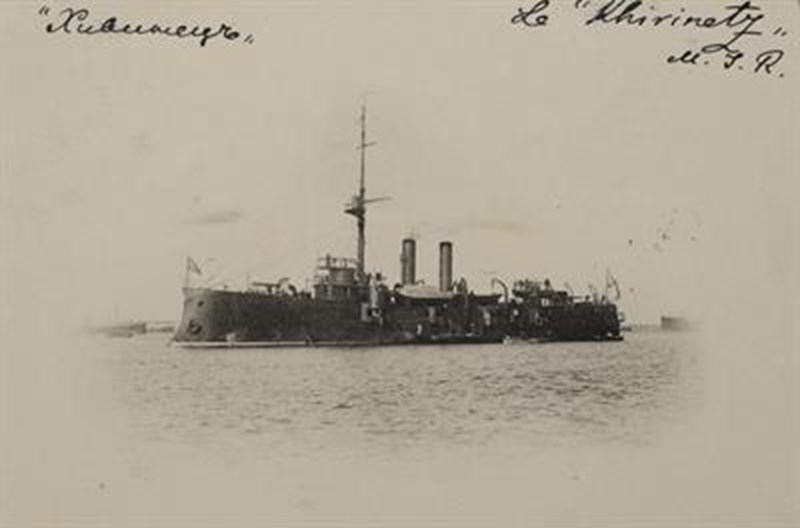
Imperial Russian Navy  – Khivinetz (Cruiser, Gun Boat, Motor Torpedo Boat)

HIRMS Khivenitz. Suda Bay 1909

HIRMS Khivenitz. Suda Bay 1909

Built in the New Admiralty Yards in St Petersburg 1905.[1] Twin Funnel 1316 tons 200 crew. Sister ship to “Giliak” and “Korietz”.  8 triple expansion Belville boilers giving designed output of 1400 HP driving twin screws; designed top speed 13 knots.[2]

Armament in 1907, 2 x 4.7-inch guns firing fore and aft, 8 x 12lb guns in centrally mounted sponsons, 2 MG.

In 1914 she was part of the Russian Baltic Fleet and is listed as taking part, under the command of Captain 2nd Rank SA Paskin, in the defence of the Baltic coast against a German invasion in ‘Operation Albion’ in September /October 1917. At this time the Khivinetz belonged to the 7th Division of Torpedo Boat destroyers, part of the Riga Bay Operations Group under Admiral Bachirev, having started the war as a detached unit in the Abo – Oland sector of the Baltic.

Disarmed April 1919

Imperial Russian Navy – No. 212 (Guardship, Torpedo boat, Motor torpedo boat)

HIRM Torpedo Boat No.212

The history of this vessel is complicated by the fact that she changed nationality several times, reflecting the complicated state of Finnish/Russian relations in the period immediately after the First World War. Depending on the sources used, she was built by the Finnish ship builders Wm. Crichton either in Ochta Yards, St Petersburg, or the Wm. Crichton yard in Turku in 1900 or 1902, under the title/number “Minonosets 212”[3]. If the vessel was that built in St Petersburg, her shipyard number was 528.

Twin Funnel ‘Yarrow ‘type.[4] 186 tons, 2500 HP, top speed 22 knots, armed with two torpedo tubes. Taken into the Finnish navy in 1917 and served under the title “S6” until 1920 when she was returned to the USSR under the Treaty of Tarto.

Alternatively:

HIRM Torpedo boat No 212

Destroyer No. 212, and 213. Russia 1903 – Built at the Okhta shipyard in St. Petersburg. The normal displacement was 205 tons. The waterline 52.3 m long, 5.25 m wide, average draft 1.6 m. The twin-shaft steam power plant had an output of 3,500 hp giving a speed of 24 knots. Armament: three torpedo tubes, three 37 mm Hotchkiss guns. In 1914, they were rearmed: the 37-mm guns removed and two 47-mm and two machine guns were installed. In 1917 they were reclassified as minesweepers. In 1918, No. 212 was captured by Finland and renamed S-6; in 1922 it was returned to the USSR and scrapped.[5]


French Navy – Faucon  (Cruiser, Torpedo Cruiser)

French Navy vessel ‘Vautour’. Sister ship to Faucon.

Condor” Class Torpedo Cruiser launched in 1887. Single funnel, 1240 tons, 134 Crew.

Designed HP 3500 – 4000, designed top speed 18 – 20 knots.[6]

Armament: 5 x 4inch guns, 6 x 3 lb guns, 4 x 1lb gun, 5 x 14-inch torpedo tubes;

11/2-inch deck armour. Listed in 1914 as being part of the 1st Submarine Squadron based in Cherbourg.

While according to another source, these torpedo cruisers were six one-funnelled ships with plough bow, considerable tumbelhome, forecastle and poop, classed as crusiers whereas they were more torpedo gunboat, somewhat large at 1,230 tonnes. The Condor, Epervier, Faucon and Vautour (birds of prey) were laid down in 1884, launched 1885-89 and completed in 1886-89, at Rochefort and Toulon. They had two shafts IC or HC engines 4 cyl. boilers for 3000 ihp and 17 knots, armed with five 3.9 in, four 3-pdr, six 1-pdr and four 14 in TTs. All were discarded between 1907 and 1911.[7]

Italian Navy –  Regina Marina Curtatone  (Gunboat)

Regia Marina Curtatone

Single funnel, 3 masts. Built Venice 1888.  1156 tons. Designed HP – 1100 giving designed 11.5 knots.

Armament: 4 x 4.7- inch guns, 4 x 6lb guns, 2 x 1lb guns (plus torpedoes?)

NB, This is NOT the Italian Torpedo Boat of the same name that sank in the Aegean on 20 May 1941 after hitting a mine whilst guiding part of the German invasion flotilla en-route to Crete.


[1] Janes Fighting Ships 1907 and subsequent editions

[2] Janes Fighting Ships 1907 lists 6 boilers, later editions list 8

[3] Janes Fighting Ships 1914

[4] According to Janes Fighting Ships 1914, ‘Normand’ type according to later editions.

[5] http://foto-i-mir.ru/squadron-minesweepers/

[6] Janes Fighting Ships 1907 states of Faucon and her sister ships ‘…present speeds very poor indeed.’

[7] https://www.naval-encyclopedia.com/ww1/France/french-cruisers  However, another sources states that the Foucon was stricken from the French naval list in 1920. http://www.navypedia.org/ships/france/fr_dd_condor.htm


Russian Poles In Crete

During the Intervention in Crete, Russia had responsibility for the control of the secteur of Rethymno. The bulk of their forces, other than a small detachment in the International zone in Canea, were based in barracks below the Venetian Fortezza. In 1899, on the orders of the Russian governor Theodore de Hiostak, Russian troops constructed, within the Fortezza, the chapel of Agios Theodoros Trichinas.

Agios Theodoros Trichinas

However, this building would not have satisfied the spiritual needs of one portion of the Russian military: Those who were Roman Catholics and would today be identified as Poles rather than Russians since, at the time of the Intervention, Poland did not exist, having finally been partitioned between Prussia, later Germany, Austria, later Austro-Hungary, and Russia in the wake of the Napoleonic Wars.

The Russian Empire made deliberate efforts to stamp out Polish nationalism and, after 1864, what education there was had to be conducted in Russian, even in elementary schools. Private education in Polish was forbidden, and young men were liable to conscription as ordinary soldiers in the Russian army if they failed to pass Russian High School exams.[1] On January 1, 1874 , a statute concerning conscription was approved by the Tsar by which military service was made compulsory for all males at the age of 20, including ‘Polish’ Russians. It is unsurprising then that amongst the Russian troops sent to Crete in 1897, there would be a number of conscripts, and possibly some officers, who would now be considered to be Polish – what they considered themselves to be is unknown.   One source states that 200-300 ‘Poles’ served in Crete.[2]

One of the main defining characteristics of ‘Polishness’ for those living in Russia was an individual’s religion; the overwhelming majority of ‘Poles’ being Roman Catholic rather than Russian Orthodox. It has to be assumed that the Russian military had some mechanism to cope with the presence of Roman Catholic troops. It is clear that at least some ‘Polish’ troops were allowed to interact with the local Catholic clergy in Canea and the Catholic church in Rethymno acknowledges the role played by ‘Polish’ soldiers in its construction.[3]

‘Polish’ Officers with Catholic priest. Canea 1898.

In Rethymno there appear to initially have been language difficulties in that the local Catholic priest, a Sicilian, could not understand his new parishioners; a problem which was overcome at the beginning of 1899, when a Polish speaking priest Marcin Czermiński came to Rethymno, becoming the de facto Catholic chaplain of the 13th Rifle Regiment of Riflemen in which the ‘Poles’ served.[4] 

Russian troops. 7Co 13 Regiment. Canea unknown date

However, an issue clearly arose when any of these ‘Polish’ troops died when in Crete. While Russian Orthodox troops could be buried in Greek Orthodox graveyards, Roman Catholic troops could not. This led to 18 ‘Polish’ soldiers being buried, not alongside their Orthodox colleagues in the churchyard of the large church of Agios Konstantinos and Eleni in Rethymno, but in a small, physically separate, cemetery nearby at the junction of Odos Tim. Vassou, and Odos Kriari.

Catholic cemetery Rethymno March 2018

Catholic cemetery Rethymno March 2018

Plaque on ourtside wall of Catholic cemetery Rethymno. March 2018

‘Polish’ soldiers’ graves. Catholic cemetery Rethymno.

(Unfortunately, the wording on the plaque, erected in 1933, is misleading. The ‘Polish’ soldiers did not die fighting for the ‘Freedom of Greece.’ They died as apart of the International force which was on Crete ostensibly to keep the peace between Cretan Muslims and Cretan Christians, but more specifically, to prevent the union of Crete and Greece and, after December 1898, to maintain the autonomous status of Crete.)

‘Polish’ soldier’s grave. Catholic cemetery Rethymno.

The names of the dead soldiers are not on their tombstones, but, along with their date of death, are recorded on a plaque on the wall inside the cemetery.

‘Polish’ memorial Rethymno

Ten of the 18 died within a three-month period between November 1898 and January 1899. In late October 1898, the Acting British Consul in Odessa reported to Sir Nicholas O’Connor, the British Ambassador to the Ottoman Empire, that sickness amongst the Russian troops in Crete was disrupting Russian plans for replacement and reinforcement on the island.[5] It is quite possible then that these ten men were part of that reported ‘sickness’ outbreak. Although of the 30 or so Orthodox Russian soldiers mentioned on gravestones or memorials in the nearby Orthodox churchyard, only two date from late 1898 to early 1899. One Polish source[6] states that three ‘Polish’ soldiers died as a result of clashes during the Theriso revolt, and the Catholic memorial lists three who died between March and November 1905, the period of the Revolt.

Many thanks to the following for their help in this article.

Dominique Kuczynska for the Polish translations

Jean-Pierre Destelle for getting access to the, normally locked, cemetery in Rethymno.

[1] http://acienciala.faculty.ku.edu/hist557/lect6.htm

[2]http://hellenopolonica.blogspot.com/2014/07/cmentarz-polski-w-rethymno.html Accessed 13 Nov. 2019.

[3] https://talesofcrete.wordpress.com/2016/11/26/the-catholic-church-of-st-anthony-in-rethymno/

[4] http://hellenopolonica.blogspot.com/2014/07/cmentarz-polski-w-rethymno.html Accessed 13 Nov. 2019.

[5] National Archive. ADM 116/93

[6] http://hellenopolonica.blogspot.com/2014/07/cmentarz-polski-w-rethymno.html Accessed 13 Nov. 2019.

Austro-Hungarians Maintain the blockade of Crete.

On 21st March 1897 following the landing of Colonel Vassos and 1500 Greek troops plus artillery, in an attempt to put an end to the further of an escalation of the Christian Cretan insurrection in Crete, the European Powers declared a naval blockade of the island. The announcement was contained in a formal note to the Ottoman authorities;

he Undersigned, Ambassadors of the Great Powers in Constantinople, have the honour to make known to the Sublime Pore, that the Admirals and Commanders of the naval forces of the Six Great Powers in Crete have decided to place this island in a state of blockade, beginning from the 9th (21st) at 8 o’clock in the morning. This blockade will extend to all ships under the Greek flag; the ships of other Powers may enter the ports occupied by the Powers and land their merchandize if not intended for the Greek troops, or the interior of the island; these ships may be visited by the vessels of the international fleet. The limits of the blockade are comprised within 23 24’ and 26 30 longitude east of Greenwich, 35 48’ and 34 45’ north latitude.”[1]

In effect, henceforth no Greek ships could land, and ships of other nationalities could only land at Canea, Retymno, Iraklion, Sitia or Irapetra to have their cargoes checked for contraband. [Discussions took place around this time about the possibility of a blockade of mainland Greece. During these discussions, the office of the Royal Navy’s Commander in Chief in Malta, who would have been responsible for carrying out any such blockade, discovered that they had lost the plans of the previous Greek blockade in 1886, and had to ask the Admiralty if London had kept copies.[2]]

While the Royal Navy was involved in a number of incidents enforcing the blockade, they weren’t the only Power to use force: At least one of the Austro-Hungarian vessels involved in the blockade saw action, the Torpedo-Ship SMS Sebenico commanded by Fregatten-Capitän Victor Ritter Bless von Sambuchi.

Fregatten Capitan Victor Ritter Bless von Sambuchi. Date unknown.

SMS Sebenico.

Austro-Hungarian Torpedo Ship SMS Sebenico

Von Sambuchi described the action to the British journalist R.A.H. Bickford- Smith who retold it in his ‘Cretan Sketches’[3]:

“The nearest approach to a sea-fight was the affair off Candia on March 19. At about ten in the morning Captain Rainier [Commanding HMS Rodney, the senior naval office in the area] received a message from the mutessarif [an Ottoman Administrator] that a Greek schooner was attempting to land provisions and ammunition near Cape Dia. The Austrian gunboat Sebenico was accordingly sent in pursuit. When she arrived within six hundred yards of the land she was fired on by the Christians on the shore. She replied, the little action lasting three-quarters of an hour. By the end of that time the schooner had been sunk about a quarter of a mile from the shore. She hoisted the Greek flag as she went down. The Sebenico was well peppered, but had no casualty; the Christians had one wounded; the crew of seven of the schooner got safely ashore. Three cases of ammunition had already been landed. Manouli, the chief of Rogdia, afterwards explained that he mistook the Sebenico for a Turk.

The accompanying sketch was made for me by Herr Ritter von Sambuchi, commander of the Sebenico.”

Sketch of encounter with blockade runner made by Sambuchi.

The incident was reported in a number of European papers and magazines.

SMS Sebenico engaging blockade runner. The Graphic.

The Graphic 10th April 1897.

“Maintaining the blockade: An Austrian cruiser sinking a Greek schooner.

On the 17th ult. [17th March] The Austrian cruiser Sebenico, while off the coast near Candia, discovered a Greek schooner landing stores. On the Sebenico attempting to lower a boat to see what was going on, a smart fire was opened on her from the schooner and from a party of insurgents on shore with a field gun. The cruiser immediately returned fire, and, with a few well Aimed shots sank the schooner, obliging the insurgents, who were onboard unloading stores and ammunition, to swim to the shore. A few more shots drove all the insurgents on shore up the hills.”

The sinking of a Greek ship by the Austrians.

Black and White 27th March 1897.

Italian view of the action.

La Tribuna Illustrata della Domenica. 4th April 1897.

As is often the case when dealing with reports of events in Crete at this time there is some confusion over the date on which the incident took place. The Graphic’s report states it occurred on the 17th March, Bickford-Smith the 19th March. While the formal blockade of Crete came into effect on 21st March, prior to this the Navies of the Powers were under instruction to prevent arms and men being smuggled into Crete.


[1]1898 [C.8664] Turkey. No. 11 (1897). Correspondence respecting the affairs of Crete and the war between Turkey and Greece.

[2] National Archives. ADM116/88. Telegram No.85. CinC Malta to Admiralty. 4th March 1897.

[3] RAH Bickford Smith 1898   Cretan Sketches Bentley and Son, London p.209